

SDG 15 - Life on Land
Explore how Lincoln University supports ecosystem protection, restoration and sustainable land use while working to prevent biodiversity loss and land degradation.
Events about sustainable use of land
Lincoln University actively supports and organises events through its State of the Land initiative that promote conservation and sustainable land use. Throughout the year, the university hosts a series of events that share knowledge, skills and best practices in land-based sectors, with a strong focus on sustainable management of forests, wildlands and agricultural resources.
In 2024, 28 events were attended by nearly 2,000 people. Almost half of the attendees were from the farming and agrifood sector. Events included discussions on the shift to smart, sustainable farming, the future of NZ’s Agricultural Workforce, the growth of the green economy, farmer wellbeing and cultivating a sustainable future together.
Another 14 events were held for farmers and food producers through the Lincoln University Centre of Excellence – Transformative Agribusiness. These included Exploring Sustainable Diets, Environmental Impacts and Nutritional Quality, and Global and Local Approaches to Climate-Resilient Land Use.
Lincoln University is also a partner and sponsor of Lincoln Envirotown Trust – is a community-based charitable trust dedicated to fostering a community-owned process for sustainability in Lincoln and making Lincoln a true Envirotown. The Trust educates, supports, researches and promotes sustainability by working with the community, for the community and in partnership with other organisations.
Katie O’Hagan, a PhD student in Soil and Physical Sciences, won Lincoln University’s Three Minute Thesis (3MT) competition with her compelling presentation on sustainable land use and the role of trees in enhancing soil carbon levels. Her research examines how strategic tree placement can help mitigate atmospheric carbon dioxide by promoting its incorporation into the soil. The 3MT event drew strong participation from students across the University, with many finalists showcasing innovative research focused on conservation and sustainable utilisation of land.
Sustainably farmed food on campus
Both our Sustainability and Procurement Policies commit Lincoln University to prioritise sustainability in all purchase decisions, including food. Section 4.6 (p 3) of the Sustainability Policy states: “Lincoln University will follow sustainable procurement principles that positively impact the economic, environmental, social and cultural well-being of the communities we live in. It will also maximise its procurement of sustainable goods, services and capital works through the goals outlined in Procurement Policy, and in compliance with all applicable rules, regulations and laws”.
Procurement policy last reviewed 26/1/24
Sustainability policy last reviewed 16/10/24
Maintain and extend current ecosystems’ biodiversity and collaboration for shared ecosystems
The Lincoln University Campus is designed to showcase our ecological and sustainable principles. In 2024, a new initiative began with the start of work on the Burns Forest. The Burns building was demolished in 2024, and the vacant landscape is being developed into an ecological zone. The initial planting was clover, for nitrogen fixing. The clover will be progressively removed as subsequent planting of native species proceeds.
The project is creating a native forest, extending and safeguarding native biodiversity on campus, providing a space to engage with the community and ensuring conservation of plant species. Plants and seeds will be eco-sourced, with many grown in our campus glasshouses.
Our research farms preserve existing biodiversity, increasing productivity whilst minimising environmental impacts. Mount Grand Station conducts long-term environmental monitoring programme with six climate stations, hosting research in areas such as soils, water, pest management, and tourism and conservation.
The ‘Future Dairy Living Lab’ consists of two mini-farms or farm-lets (currently 12 ha each) within the larger Lincoln University Research Dairy Farm, which focuses on landscape enhancement, biodiversity and resilience in soils, plants, animals and people.
The Lincoln University Arboretum comprises half a hectare of exotic and native flora and fauna, including the largest collection of magnolias in the South Island. Since 2021, a revitalisation project has secured the restoration and ongoing protection of its biodiversity.
Lincoln University is also involved in community projects to protect and preserve the local ecosystems and biodiversity. The University provides ecology advisors and volunteers to regularly participate in maintenance work as part of a native regeneration project at Mahoe Reserve in Selwyn. A former shingle pit, over 7,000 native tree, shrubs and grasses have been planted since 2003. The reserve is managed by Lincoln Envirotown, of which Lincoln University is a sponsor.
The project is working to improve biodiversity by planting appropriate native plants that provide a food source, shelter and encourage native species, restoring plants that are locally sourced so that they are genetically as close as possible to the original plants found in this area, and using simulated habitat refuges to support species establishment.
In 2024, Lincoln University researchers worked with Pest Free Banks Peninsula to test audio, visual and social lures when trapping possums. This community and government partnership aims to eradicate pests from the area, thereby restoring and protecting native biodiversity. The trials showed audiovisual and social lures used in a trap (cost-effective and easy to attach) were significantly more effective than the non-lured sites. Lincoln University's participation doubled the number of possums caught. Outcomes include other predator-free sites are interested in using the technology.
The waterway site at Ararira Springs in Lincoln township has been restored and developed, with regular planting events being held – adding to local native biodiversity. Prior to the building of Ararira Springs School, which runs alongside the waterway, ecological assessments of the Liffey waterway were carried out and several important instream species – such as bluegill bullies, longfin tuna/eels and kōura/freshwater crayfish - were found to be present in the waterway. As a result, the restoration project was carried out in an ecologically sensitive manner to avoid adverse impacts on instream species. Native planting at the site began in recent years with volunteers from local primary schools and Lincoln University students.
Education programmes on ecosystems for local or national communities and educational programmes on ecosystems
Schools Outreach and Education
Lincoln University holds on-farm free workshops throughout the year. Targeted at secondary school students, the workshops highlight the importance of science to solving sustainability challenges in the primary sector and protecting our ecosystems.
The University has also provided teaching resources for senior secondary school students, including unit plans with classroom activities and teaching notes to student workbooks and New Zealand case studies.
- Level 2 Pest Management Resources: Predator Free 2050 teaching unit with classroom activities and a Pest Management Student Workbook. Recommended for science and geography students.
- Level 1 Dairy Farming, the Environment and Sustainability: Teaching unit with classroom activities. Recommended for agriculture, science and geography students.
Lincoln University researchers support the Lincoln High School ‘Adopt-a-scientist’ programme, voluntarily working with students on science projects. Many are focused on ecology and pest management, protecting native fauna and flora.
Judges are also provided for the Canterbury Westland Science Fair, and sponsor three special prizes. These recognise our areas of excellence and include ecosystem protection:
- Best exhibit investigating pest management
- Best exhibit demonstrating the ideas of design for nature
- Best exhibit involving sport science.
In 2024, more than 500 children from 17 local schools were invited onto the campus across two days to learn more about the world around them. Lincoln University works in partnership with the University of Canterbury to deliver the Mātāpuna Mātātahi Children’s University in the Canterbury region. Activities included a close-up experience with spiders in a session run by the department of Pest Management and Conservation, as well as sessions on fungi, soil and plant diseases.
Community Outreach and Education
Lincoln University has several collections on iNaturalist, an online social network of people sharing biodiversity information to help each other learn about nature and flora and fauna. Users can upload photos to identify a species or look through the database to learn about their local ecosystems. It helps people engage with nature and build their knowledge of what is around them. Lincoln University collections include mammal tracking, bird surveys, invertebrate surveys and plants.
In April 2024, Lincoln University supported the Mahoe Reserve mini bioblitz, both as a sponsor of the organiser, Lincoln Envirotown, and with volunteers to help identify species of birds, insects, fungi and plants. A total of 194 observations were uploaded to iNaturalist, covering 108 species. This collaboration between scientists and the public provided a snapshot of biodiversity within the local ecosystem, with the collected data helping to inform conservation efforts and scientific understanding.
The University community day and open days on our farms provided further opportunities to meet with the public and educate on sustainability and biodiversity protection in both our agricultural and wild ecosystems.
Sustainable management of land for agriculture (education outreach)
Lincoln University hosts many educational outreach events throughout the year to showcase innovative and sustainable management of agricultural land. These are designed to engage the community – those within industry, iwi, government, policymakers and the general public.
Lincoln University has two demonstration farms – Lincoln University Dairy Farm (LUDF) and Owl Farm, which regularly host events on-farm. Owl Farm is a joint venture between St Peter’s School, Cambridge, and Lincoln University, established to take on a leadership role in demonstrating best practice dairy farming and sustainable farming practices on a working farm. The dairy farm annually opens its farm gates to the public to share agricultural knowledge with those in the industry and beyond. Owl Farm also provides an opportunity for school-aged children to learn about the career opportunities in the food and fibre industries.
LUDF is managed by the South Island Dairying Demonstration Centre (SIDDC), an industry-funded partnership of seven leading dairy sector organisations. These partners work to promote sustainable dairying through collaborative research and extension for farmers. The primary aim of LUDF is to develop and demonstrate world-best practice in pastoral dairy farm systems for transfer and adoption on farm. Implementing research, technology and practices to protect people, cows and the environment – both now and into the future. Each week, the LUDF farms host farm walks. Farm data is available for free online and summarised in weekly newsletters. The environment and sustainable management of agricultural land are a key focus.
Based on Ashley Dene Research Farm, the Integral Dairy Health Farm (IHDF) utilises an alternative system of dairy farming, focusing on a holistic method that measures improvements in the health of soil, plants, animals and the community. It’s a demonstration of how current dairy farms could feasibly transition to more sustainable and healthy methods.
Lincoln University’s Farms Educational Facilitator hosts predominantly urban high school students on the University’s demonstration farms, enabling them to experience a working farm, sustainable land use and gain insights into potential careers in the food and fibre industries.
Lincoln University’s Regenerative Agriculture Dryland Experiment regularly hosts public field days. At these events, the research team demonstrate the results from research comparing regenerative and conventional dryland farmlets specialising in sheep production and achievements in employing more sustainable farming methods. Speakers discuss various aspects of farming, including soil measurements and phosphorus requirements and fertiliser applications, along with the effectiveness of multi-species pasture mixes and regenerative management.
Lincoln University is a learning destination for Mātāpuna Mātātahi Children's University. Activities include growing your own greens, learning about moths and biodiversity to protect the environment, and how you can farm sustainably.
Sustainable management of land for tourism (education outreach)
Lincoln University’s tourism qualifications place strong emphasis on sustainability and the environment. The Bachelor of Sustainable Tourism addresses global sustainability challenges facing the industry post-pandemic, with experts needed to develop sustainable tourism systems that will provide strategic management of sustainable tourism operations.
New in 2024, the Bachelor of Sustainable Tourism was launched to provide students with a unique, industry-relevant programme that addresses real-world challenges and promotes sustainable tourism practices. The public launch featured an expert panel discussing indigenous perspectives on sustainability, current themes of tourism policy and governance, and environmental sustainability in tourism.
Lincoln University's Dr Jo Fountain, with Quality Tourism Development, published a practical guide to successful agritourism as part of the Postquake Farming Project. The guide, Agritourism in New Zealand, is freely available online.
Lincoln University researchers have also been working on local attitudes towards conservation of Te Waihora | Lake Ellesmere. They found that facilitating sustainable access to the lake can help stimulate visits, develop positive attitudes towards the lake and garner support for conservation and sustainable land use in the catchment.
B.linc hosted an event in 2024 looking at the growing global interest in sustainable tourism. New Zealand's Agritourism was discussed, with farmers and rural communities increasingly recognise the potential of Agritourism as a supplemental source of income. The integration of technology, such as virtual farm tours and interactive educational experiences, is likely to enhance the appeal of Agritourism in New Zealand, making it accessible to a broader audience. As the world becomes more conscious of the origins of food and the importance of sustainable practices, New Zealand's Agritourism is well-positioned to flourish, offering visitors a deeper connection to the land and the people who cultivate it.
Sustainable use, conservation, and restoration of land (policy)
Lincoln University is committed to the conservation, restoration and sustainable use of terrestrial ecosystems associated with our campus, including farms, drylands, and other natural landscapes for current and future generations.
With a commitment to being an exemplar of sustainable practices in the land-based sector, our Sustainability Policy guides our efforts in preserving biodiversity and maintaining ecological health across campus.
The policy states, ‘Lincoln University will improve biodiversity on campus and seek to identify, monitor, and protect any IUCN Red Listed species and NZTCS listed species in areas affected by university operations.’
The commitment to conserving and enhancing biodiversity goes beyond campus to all University properties with threatened species and native planting. This includes Lincoln University demonstration farms, which display leadership, contributing to solving sustainability challenges in the land-based sector through knowledge sharing and solving global sustainability issues.
Dryland Pastures Research (DPR) provides scientific guidance to sheep farming on dryland pastures, with the aim of developing dryland pastoral farms that offer resilience to climate variability and climate change. The work has a legume focus to provide a sustainable solution for overcoming the chronic nitrogen shortage prevalent on all pastoral and arable farms. The team regularly updates New Zealand farmers with the latest information through field days, discussion groups, a text alert service on lucerne management, and a dedicated website.
Sustainability policy last updated 16/10/24
Monitoring IUCN and other conservation species (policies)
Lincoln University clearly states in its Sustainability Policy the guidelines for preserving biodiversity and maintaining ecological health across campus, in particular, IUCN Red Listed species. The policy states, ‘Lincoln University will improve biodiversity on campus and seek to identify, monitor, and protect any IUCN Red Listed species and NZTCS listed species in areas affected by university operations.’
This commitment to conserving and enhancing biodiversity extends beyond the campus to all University properties, including those with threatened species and native plantings, as well as Lincoln University’s demonstration farms.
In April 2024, Lincoln University joined the City Nature Challenge, an international event that encourages people to explore nature and capture photos of plants, animals, and fungi, uploading them to the iNaturalist app for monitoring pests and conserving species. Lincoln University has dedicated pages and groups within iNaturalist for monitoring the campus with both citizens and scientists able to upload. The information is used for biodiversity research, species monitoring and conservation efforts
Sustainability policy last updated 16/10/24
Local biodiversity included in planning and development
Lincoln University’s Landscape Masterplan, which forms a part of the University’s Campus Redevelopment Programme, incorporates local biodiversity into its planting plans, with one of its design objectives to enhance the biodiversity on campus. The plan sets out to connect existing native vegetation areas into an extended network, with new eco-sourced plantings and a central ecological core.
Planting types and groupings align with both the Lincoln Envirotown vegetation strategy and Mahinga Kai values of the Lincoln University cultural narrative and Te Taumutu Rununga. Where possible, new developments will incorporate broad-scale eco-sourced native planting and long-term plans for successional tree replacement to ensure native species are incorporated into the canopy.
Lincoln University’s Sustainability Policy states that ‘Conserving water and native (or indigenous) biodiversity will be key design consideration on all our capital infrastructure projects’ as outlined in the Landscape Masterplan discussed above.
Alien species impact reduction
Lincoln University manages alien species impacts on campus through a combination of policy and direct action. The Vertebrate Pest Control Policy dictates the ethical and humane elimination of introduced species, such as rabbits and possums, which threaten native flora and fauna. This physical control is complemented by the Landscape Master Plan, which minimises the opportunity for other alien species by prioritising and implementing native planting and enhancing ecological corridors, thereby actively reducing the space and resources available for invasive plants to become established on University-controlled land.
Lincoln University’s Vertebrate Pest Control Policy was last modified and updated in 2024.
Lincoln University's Landscape Master Plan guides the use of native planting and the enhancement of ecological corridors. Prioritising native species over alien ones is a core strategy for limiting the physical space and resources available to invasive plants and pests on campus.
Natural systems and sustainable drainage on campus
Part of the University’s Landscape Master Plan includes a focus on natural systems and sustainable drainage. While a physical design, it explicitly outlines operational guidelines implemented to meet water quality standards and protect ecosystems, wildlife, human health and welfare by controlling discharge.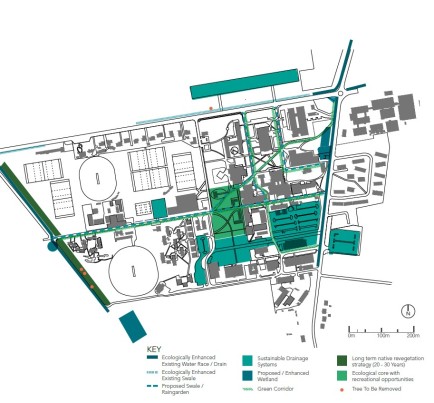
The Landscape Masterplan mandates the incorporation of raingardens and planted swales into paved areas. This serves as a primary guideline to deliver the "highly valuable ability to filter runoff and pollutants in the hardscape environment," thereby pre-treating discharge to safeguard human health and downstream ecosystems.
It also sets a clear guideline that hardstand areas must combine planted swales, raingardens, and permeable paving to actively "further reduce the number of contaminants entering the water system." This dictates a necessary management practice to minimise pollution risks to both water users and natural habitats.
There is also a requirement for enhancing existing water races and swales and connecting them to wetlands and stormwater basins. This guideline ensures that discharge is managed across a natural purification network, maximizing detention time and promoting ecological function to protect the health of receiving waterways.
The overall strategy, where appropriate, aligns with the Lincoln Envirotown Strategy, implicitly committing the University's discharge management efforts to the broader community's local environmental goals, which includes the conservation of local ecosystems.
Hazardous waste disposal
At Lincoln University, we are committed to sustainability through responsible recycling and waste management practices. This includes various types of hazardous waste, including toner cartridges, batteries, oil, fluorescent bulbs and chemicals, which are managed and recycled appropriately. Chemical and toxic waste is disposed of via a specialist company.
Laboratories on campus follow strict procedures which outline the use conditions and safe disposal of hazardous and toxic materials. A separate policy outlines responses to the discovery of asbestos, including removal by qualified professionals who must provide a receipt for the safe and proper disposal of hazardous material.